
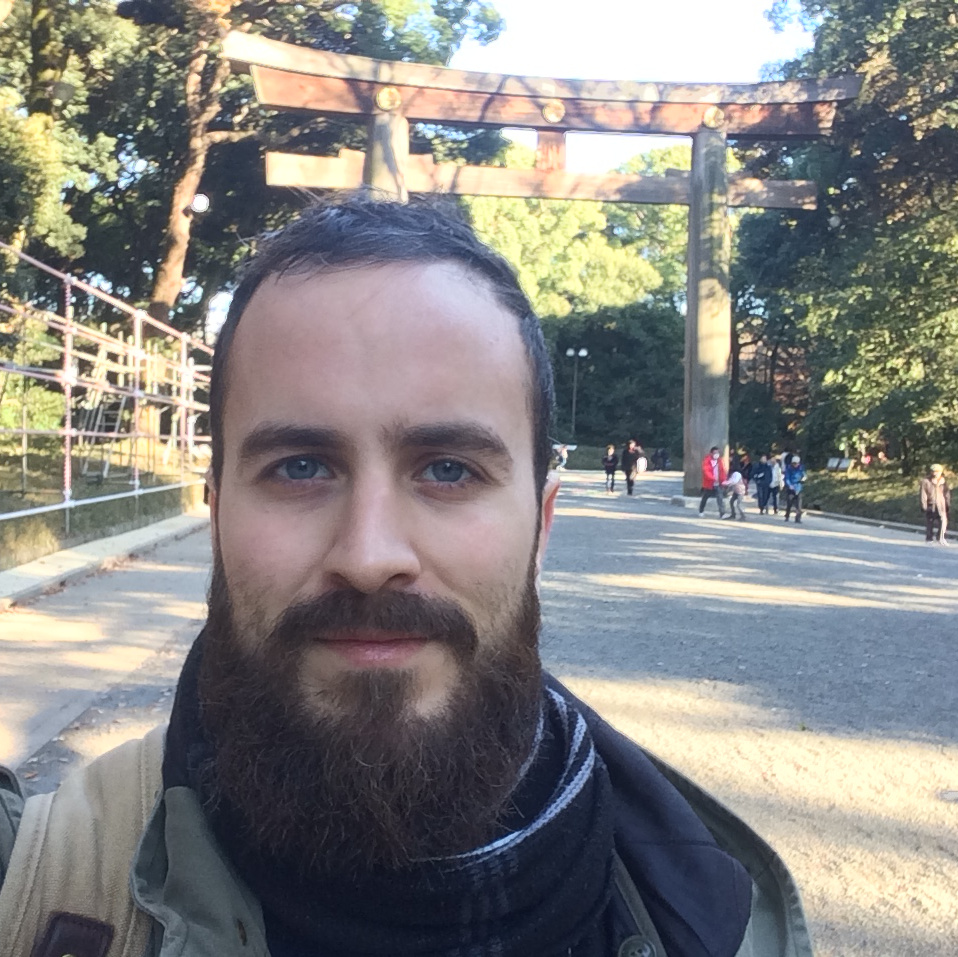
Manuel Baltieri
バルティエリ・マニュエル
Chief Researcher at Araya Inc. and Member of the Board of Directors, ISAL – International Society for Artificial Life
Manuel’s research interests address theories of agency, building a formal understanding of how agents, informally defined as autonomous systems acting on their environment to fulfil their goals can be described in a mathematical framework. His past work focused on the free energy principle and active inference, developing models of minimal agents, and studying their properties in the larger Bayesian framework advocated by these approaches. His current working hypothesis is that an autonomous system can be called an “agent” only if it models relevant parts of the environment while interacting with it. In his current work, he is thus developing formal notion of internal/world models, studying their existence, necessary/sufficient conditions, and role in building a general theory of agency.
The Role of the Free Energy Principle in AI Safety: Markov Blankets and Beyond
Saturday, April 6th, 10:00–10:30
Active inference, an influential framework in computational neuroscience and theoretical neurobiology, begins with the premise that systems ensure adaptive interactions with their environment by minimising an objective function represented as a free energy functional. This functional is derived from the free energy principle, a theory explaining how systems (agents) are distinguished from their environment based on a notion of statistical independence. This independence, in turn, relies on a construct, Markov blankets, frequently advocated by proponents of the free energy principle to carve out the boundaries between an agent and its environment. In this presentation, we will explore these concepts and their influence on recent developments in the field of AI safety, analysing the significance of the free energy principle and active inference in defining “what agents are” and “what agents do”, respectively. By the end of the talk, we will address some possible limitations of these frameworks and examine new proposals aimed at clarifying the potential confusion in the literature between the formal use of Markov blankets as an epistemic tool for active (Bayesian) inference and their novel metaphysical application within the free energy principle.
 Technical AI Safety Conference